>> HOMEpage
Sarton:
Johannes Antonides vander Linden
Bron: Johannes Antonides vander Linden (1609-1664) : medical
writer and bibliographer
In: Science, medicine and history. Essays on the evolution of
scientific thought and medical practice ... London, Oxford
University Press, 1953. Vol. II, p. 3-20.
Internetuitgave: M.H.H. Engels, november 2026
De illustraties uit de Boston Medical Library en de portretten
vervangen door online boektitels en dito portretten.
MEDICAL WRITER AND BIBLIOGRAPHER
by
GEORGE SARTON
I. Life.
II. Main writings.
III. De scriptis medicis.
IV. Activities as a medical editor.
V. Views on the circulation of the blood.
VI. Iconography.
VII. Bibliography.
I. Life
The remarkable man to whom this article is devoted belonged to
a learned family of Northern Holland. The earliest member known
to me was one Antonius, schoolmaster and cantor, probably in Naarden.
One of Antonius's five sons was Henricus Antonii Nerdenus (i.e., of Naarden);
that is how he called himself after the Latin manner of that time. Henricus,
born in Naarden in 1546, was a minister, theologian, and author of many
Latin treatises. When the University of Franeker was founded in 1585[1] he
was one of the first professors of theology. Indeed, Henricus was one of the
most distinguished professors of the new foundation. His last book was a
history of it, Initia academiae franequerensis, ejusdem templi et gubernationis
(Franeker, 1613). He died in Franeker in 1614. His descendants assumed
the name Vander Linden and called him retrospectively Henricus Antonides
vander Linden. It may interest English readers to know that when John
Locke was a political refugee in Holland (1685-89), hiding in Amsterdam,
he assumed that very name, Van der Linden.[2] One of his children, Antonius
Hendrikszoon, or more formally Antonius Antonides vander Linden, was
born in 1570, studied medicine in Franeker and established himself in
Enkhuizen (on the west coast of the Zuider Zee), where he practised medicine
and was rector of the Latin school. The subject of this article is his son,
Johannes Antonides vander Linden, born in Enkhuizen on 13 January 1609.
Johannes matriculated in 1625 at the University of Leyden, where he studied
the classical literatures, natural history and medicine. In 1629 he went to
Franeker, at the university of which his grandfather had been one of the first
professors and his father an alumnus, and on 19 October 1630 he there
obtained his medical degree with a thesis De virulentia venerea. In 1631
he joined his father, who had established himself in Amsterdam, and began
in that city the practice of medicine. The father died in 1634. A few
years later (1637) Johannes was appointed Inspector Collegii Medici and, in
1639, professor at Franeker. In his inaugural oration he discussed the
requirements of the new physicians (De medico futuro necessariis). At that
1 The earliest university of the Netherlands was Louvain, founded in 1425, but the earliest
in the northern provinces (Modern Netherlands) was Leyden, founded in 1575; the second was
Franeker, founded in 1585. Leyden and Franeker were Protestant institutions while Louvain
remained a militant Catholic one. The two Dutch universities exerted some influence upon
Harvard College, and the Harvard motto 'Christo et Ecclesiae' was derived from the Franeker
dedication. The university of Franeker was suppressed in 1811, but Leyden still exists, and
was at the time of the German invasion one of the most important universities in the world.
2 Henry Richard Fox Bourne, Life of John Locke. 2 vols. London, 1876, vol. ii, pp. 25, 46.
4
time he was still deeply interested in medical 'realia', for he tried to obtain
cadavers for dissection and to enlarge or improve the botanical garden of
Franeker. However, in 1648 the university library was entrusted to his care,
and he took considerable pains to increase it. It is probable that his charge
as librarian took him away more and more from the dissection room and the
garden, and intensified his bibliographic and humanistic tendencies. In 1649
he refused an appointment in the newly founded University of Utrecht,[3]
but two years later he could not well decline another offer made by the
University of Leyden whose prestige was already considerable. He read his
inaugural oration in that city on 17 June 1651. He seems never to have
abandoned the practice of medicine, and in Leyden he conducted a clinic
with his colleague, Albert Kijper (d. 1655). However, his main interest lay
in medical writings.
He was a good classical scholar and became what was
then called a 'philologus medicus', and would be called to-day a medical
historian and medical bibliographer.
He had married Helena Grondt, was a friend of the famous Dr. Nicholas
Tulp (about whom more anon), and was an esteemed practitioner. He was
a great admirer of the ancients, chiefly Hippocrates and Aristotle, but had
learned to appreciate some of the moderns, such as Descartes and his own
Leyden colleague, François de le Boë of Cambrai, alias Franciscus Sylvius
(1614-72). Sylvius's medical fame was far greater than his own, but Vander
Linden became for a time the main authority in his own field, medical biblio-
graphy. He died in Leyden on 5 March 1664, at the age of fifty-five years and
in the twenty-third year of his professorate.
II. Main Writings
There is no need to enumerate all his publications which would take
considerable space, for it would include not only his technical writings but
also the academic orations, which he delivered according to custom when his
students obtained their medical degree or in other circumstances. We shall
refer to his activities as an organizer and moderator of doctoral theses in
another chapter.
His literary activity began with his own graduation as an M.D. at Franeker
in 1630. Various items date from that year, notably his doctoral thesis
De virulentia venerea and the exercises in which he took part at the time of
Winsemius's retirement. Menelaus Winsemius had been a professor of
medicine in Franeker; after his retirement he seems to have devoted himself
to the creation of a botanical garden there, He died in 1639.
In 1637 appeared the first edition of Vander Linden's De scriptis medicis,
the medical bibliography which is to-day his main defence against oblivion.
A special chapter is devoted to it below.
The first edition of that book included, as a kind of introduction, the
Manuductio ad medicinam (50 pp.), a summary of medical bibliography. The
Manuductio was reprinted thrice, not by the author, but by two other Dutchmen,
the first established in Louvain and the second in Helmstedt. The second
3 To the two early Dutch universities had been added during the first half of the seventeenth
century four new ones, Groningen in 1614, Amsterdam in 1631, Utrecht in 1636 and Harderwijk
in 1648. This illustrates the great vitality of the Free Netherlands in that age, and also the
competitive spirit of its cities.
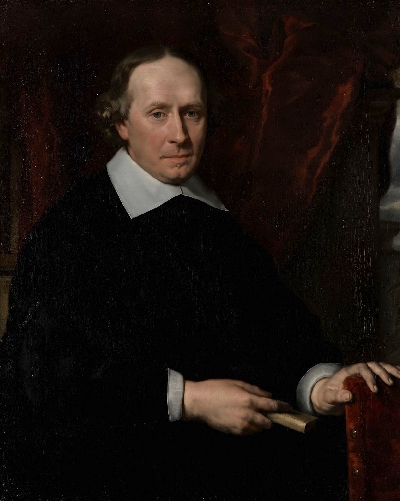 Fig.1. JOHANNES ANTONIDES VANDER LINDEN (1609-1664)
Picture of 1660 by Abraham Van den Tempel
(Mauritshuis, The Hague)
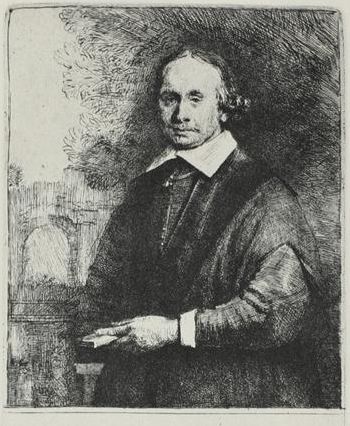
JOHANNES ANTONIDES VANDER LINDEN (1609-1664)
Etching of 1665 by Rembrandt
5
edition was published by Professor Plemp in Louvain (1639) with additions
of his own. This Plemp, or more correctly Vopiscus Fortunatus Plempius
(1601-71), was an Amsterdamer, who was professor of medicine in Louvain
and distinguished himself as the leader of the anti-Cartesian party in Belgium.
The third edition was inserted by the polyhistor Hermann Conring (1606-81)
in his book In universam artem medicam ... introductio (Helmstedt, 1687;
reprinted 1688). Conring was of Dutch origin, but born in East Friesland.
Other books of Vander Linden are :
Medulla medicinae, partibus quatuor comprehensa. (Vol. i in 2 parts.) Franeker,
1642. (Presumably a medical text-book for his students in Franeker.)
De monstrosis vermibus observatio rara, in his edition of Adrian van den
Spiegel's Opera omnia. Amsterdam, 1645.
Historia aegrotorum vigintiquinque. Amsterdam, 1651.
Medicina physiologica, nova curataque methodo. Amsterdam, 1653.
Selecta medica, et ad ea Exercitationes batavae. Amsterdam, 1656.
De hemicrania menstrua historia et consilium. Leyden, 1660.
Meletemata medicinae hippocraticae. Leyden, 1660. (Republished by Johann
Jacob Doebel (1640-84), Frankfort, 1672.)
III. 'De scriptis medicis'
Vander Linden's opus magnum, his medical bibliography, appeared for the
first time in Amsterdam in 1637. This was not the first attempt of its kind.
Leaving out many ancient, Arabic.and medieval models, the first in modern
literature was probably that given by Symphorien Champier of Lyons
(1472-1533) as early as 1506 (Libelli duo. Primus de medicinae claris
scriptoribus ... Lyons, 1506). Champier was a very prolific[4] but uncritical
author; his bibliography may interest antiquarians, but it is no longer
serviceable, as Vander Linden's still is. The latter's work was printed no
less than four times in half a century, each edition being considerably emended
and enlarged.
The Boston Medical Library owns copies of the four editions, and
thanks to the courtesy of its librarian, Dr. Henry R. Viets, I was permitted
to keep them all for some time in my study at the Widener Library, and was
thus able to make a detailed analysis of each and to comparethem.
In spite of many corrections and additions, these four editions remained
essentially the same. The author's aim was to give a complete bibliography
of the printed medical writings available at the time of publication. Some of
the additions in each edition were due to the simple fact that new books had
appeared since the publication of the previous one (the four editions being
dated 1637, 1651, 1662, 1686). Each of these volumes is worth having for
a rapid conspectus of the medical literature from the end of the fifteenth
century to 1637 (or to from fourteen to forty-nine years later), but the last,
posthumous, edition of 1686 is of course the richest and the best. Even in
the last edition the bibliography is far from complete, but it is generally
4 See his bibliography in Vander Linden under Symphorianus Campegius Lugdunensis
(pp. 437-40, 1637; or 547-51, 1651; or 578-82, 1662; or 986-90, 1686). This is a good way
of comparing the four editions. For other pre-Vander Linden medical bibliographies sce
Henry R. Viets (1938).
6
sufficient for a first investigation. The incunabula seem poorly represented,
but that is not very surprising and we have other tools to handle them.
Vander Linden's bibliography is especially useful for the sixteenth century
which it covers, or is supposed to cover, completely. Until the Army Medical
Library has realized its ambitious project in that field,[5] we shall be very glad
to have Vander Linden at our elbow.
Let us now consider each edition in turn. The title pages being
reproduced herewith, a minute description of them is unnecessary.
The three editions published within the author's lifetime were all issued
from the same officina, that of Johannes Blaeu (1596-1673), the illustrious
cartographer of Amsterdam. The first (1637) is a volume 22 cm. high, of
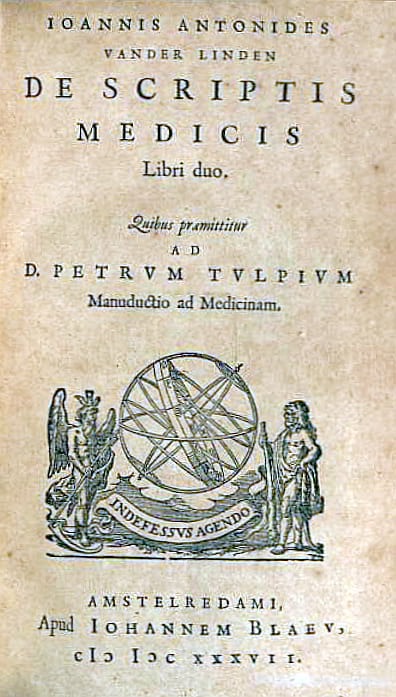
Fig. 3. De scriptis medicis. Title-page of first edition, 1637.
50+560+22=632 pages closely printed. The first fifty pages contain a medical introduction (Manuductio ad medicinam) dedicated to Peter Tulp, son of Dr. Nicholas Tulp, ex-alderman, senator, physician and anatomist of Amsterdam (thus, in the dedication).
This Nicolaes Pieterszoon Tulp was born in Amsterdam in 1593 and spent
the best part of his life in his native city, but died in The Hague in 1674.
He obtained his M.D. at Leyden in 1614 with a thesis De cholera humida. He
then established himself in Amsterdam, where he soon gathered a lucrative
practice and a large circle of friends. He was one of the first practitioners in
5 Isis, 1941-2, xxxiii, 726.
7
that city who used a coach to visit his patients. He was elected alderman in
1622 and was many times re-elected. From 1629 to 1653 he was prelector of
anatomy in the surgical college. An admirable and unforgettable portrait
represents him in that capacity as the central figure in A Lesson in Anatomy,
which Rembrandt painted for the medical guild of Amsterdam in 1632; it is
one of the masterpieces of the Mauritshuis in The Hague.[6] Tulp's only
scientific book, Observationes medicae, was published a few years later
(Elzevir, Amsterdam, 1641), many times reprinted (1652, 1672, 1685, 1716,
1739), and published in a poor Dutch version (1650, 1740). That little book con-
tains some two hundred clinical histories and the first description of the
'Orang-outang', which he believed to be the satyr of the ancients.[7] Nicholas
Tulp was burgomaster (mayor) of Amsterdam in 1654 and many times after-
wards. He was a trustee and curator of various institutions, was one of the
founders of the Collegium Medicum, and took a large part in the preparation of
the first Amsterdam pharmacopoeia (1635). A fashionable doctor, a distin-
guished anatomist, one of the organizers of the medical profession and teaching
in his native city, trustee, representative, alderman, mayor, he was undoubtedly
one of the most important personalities of his time and country, and thanks to
Rembrandt's genius, he will live for ever in the memory of men.
We know nothing concerning Nicholas's son, Peter Tulp, but as Nicholas
was forty-four in 1637, it is possible that his son was then a student or preparing
to be one. Vander Linden, being sixteen years younger than the elder Tulp,
was somewhat older than the son. Hence it was natural for him to dedicate
the Manuductio to the son rather than to the father, who had passed the need
for it; the dedication to the son was an indirect and delicate homage to the
illustrious father. We may be sure that the latter was already illustrious, not
only because of his civic and medical activities, but even more so because of
Rembrandt's astounding painting.
To return to De scriptis medicis, the main part of the book is a bibliography
of the printed medical writings in alphabetical order of the authors' names.
The titles of books are quoted very fully, the number of pages is never
mentioned, the size always. This was useful, for in the ancient libraries
books were generally classified according to size, all the folios being together,
and so the quartos, the octavos, etc.[8] This saved space and simplified one's
search if the format was known. The alphabetical order is based on the
Christian names (and the same was done in every edition, even in that of 1686).
Thus all the Abrahams are together, as well as all the Johns and the Georges.
Galen himself appears with the other Claudii, his name being wrongly
supposed to be Claudius Galenus.[9] Happily, there is an index of cognomina
at the end. There is also an elaborate subject index referring to the authors
who deal with each subject. That index is arranged in systematic order,
6 For a description and abundant literature, see Mauritshuis, Catalogue raisonné. 3rd edition.
The Hague, 1935, pp. 275-8.
7 M. F. Ashley Montagu, Edward Tyson, 1650-1708. Philadelphia, 1943. [See Isis, 1942-3,
xxxiv, 526.] Tulp's illustration of 'Homo sylvestris, orang-outang' is reproduced on p. 251 of
Montagu's book. This 'orang-outang' is really a chimpanzee.
8 The same method is sometimes used in the rare book sections of modern libraries, e.g., in
the Boston Medical Library (Isis, 1943-4, xxxv, 218).
9 See my Introduction to the history of science, Baltimore, vol. i, 1927, p. 302.
8
beginning with generalities, 'Medicina et quae ad medicinam in genera' (sub-
divided under such headings as ars, historia,[10] studium, defensio, introductio,
isagoge, compendia, aphorismi, Avicenna, epistolae, etc.); then Medici,
Veterinaria, Empirica, Dogmatica, Theoretica, Physiologica, Anatomica,
Pathologica, Nosologica, Aetiologica, Symptomatica, Semeiotica, Diagnostica,
Urocritica, Sphygmica, Oneirocritica, Physiognomica, Chiromantica, Prog-
nostica, Practica, Diasostica, Aerologica, Hypnologica, Gymnastica, Eccrimo-
logica (excrementa, sudor, coitus, lacrymae ...! ), Pathologica, Cosmetica,
Prorogatio (vitae), Therapeutica, Specialis (special diseases), Diaetetica,
Pharmaceutica, Chirurgica (this includes balneology), Methodica, Chemica
(et quae ad alchimiam), Paracelsica. That classification is mediocre, for its
order is capricious and some headings duplicate others; it makes a painful
impression for it shows to what extent science and superstition were still mixed.
That was of course not Vander Linden's fault; he was a child of his time, but
the whole arrangement suggests that he was more of a bibliographer than a
philosopher.
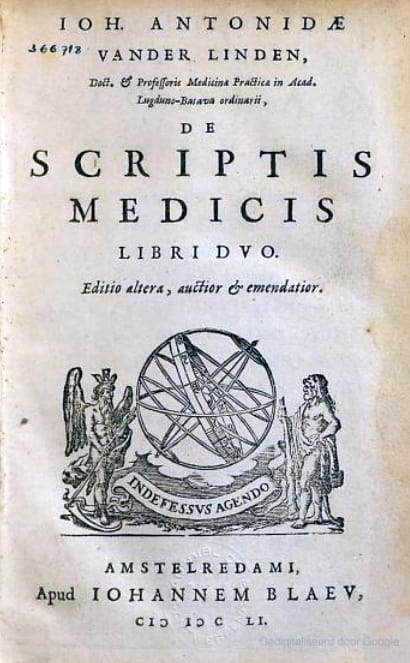
Fig. 4. De scriptis medicis. Title-page of second edition, 1651.
The second edition (1651) is a volume of 730 pages, 18 cm. high, less well
printed than the first edition and less handsome. This edition
and the third do not include the Manuductio which was somewhat irrelevant;
thus more space was available for the bibliography proper. This edition and
the third are dedicated to Dr. Nicholas Tulp; the full dedication is similar in
both editions. We reproduce it from the third which is longer and more
elegantly printed (Fig. 7); it completes our short biography of that famous
Amsterdam physician and magistrate.
10 With the single reference to Ioannes Henricus Alstedius (1588-1638).
9
As an example of the additions in the second edition I noticed a long article
on Jean Baptiste van Helmont (1577-1644), missing in the first, though one
of Helmont's treatises had appeared as early as 1621. The second edition
includes a poem addressed to the author by his Leyden colleague, the famous
theologian Ioannes Cocceius (1603-69), the same who read an academic
oration at his funeral.
The third edition (1662) is again somewhat larger, forming a volume of
806 pages, 20'5 cm. high, more carefully printed than the second. This third
edition is essentially the same book as the previous edition, but is richer and the
subject index, arranged somewhat differently, is more detailed. I noticed
many new headings; it is clear that many of those headings were simply
Fig. 5. De scriptis medicis. Title-page of third edition, 1662.
derived from the title of a book and calculated to help one find the author's
name if one remembered only the main words of the title (e.g., Hermes
academicus, Lanx satura rerum medicarum, Hippocrates sive doctor verus).
The chemical classification is much extended. Among the new medical
headings I noticed Antepractica, Thematica, Erotematica (ingressus ad aegros,
interrogandi aegros modus), Bouleutica (consultandi methodus, consilia),
Postpractica (defuncti medicatio, cadaverum conditura). This third edition,
the last which the author could supervise, for he died a couple of years later,
must have been an excellent bibliographic vade-mecum for learned doctors and
librarians. It is really very convenient once one has learned the use of it. It
enables one to find promptly not only what every physician of the past has
10
written, but to discover the best books on any medical subject, or to identify a
book of which one remembers only the subject or a part of the title. We may
observe in passing that titles in Latin, being more flexible than those in English,
were quoted incorrectly more often than not. Ancient scholars did not attach
as much importance to the literal quotation of a title as we do; they were often
satisfied with the gist of a title. However, as long as one remembered the
outstanding words in any order, Vander Linden's book enabled one to find the
full title, date and place of publication and the author's name.
The fourth edition (1686) differs materially from its predecessors. It
was printed in another city, even in another country, in Nürnberg, twenty-two
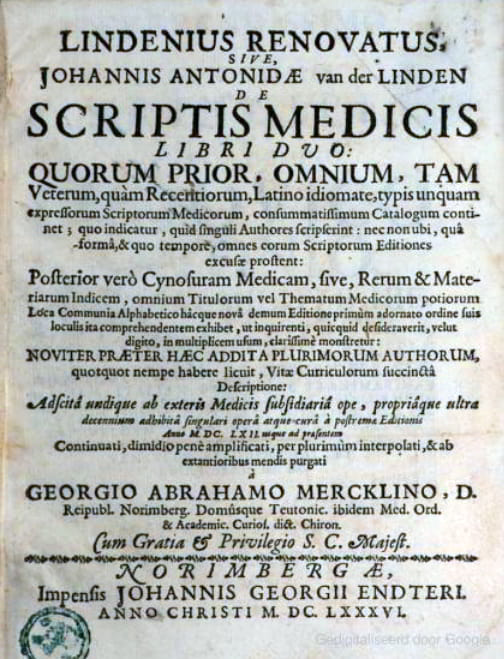
Fig. 6. De scriptis medicis. Title-page of fourth edition, 1686.
years after Vander Linden's death. It was dedicated no longer to a debonair
Amsterdam patrician but to the 'reverendissime' and 'serenissime' prince
Ludovicus Antonius, duke of Pfalz-Neuburg, grand master of the Teutonic
Order. Considerably larger than the earlier editions, its two volumes
extended to 2230 pages printed in two columns
The new editor was Georg Abraham Mercklin (1644-1702), a native of
Middle Franconia practising medicine in Nürnberg. According to his own
title page, Dr. Mercklin was a member of the Nürnberg republic, an ordinary
doctor of the Teutonic Order (which explains his fulsome dedication to the
grand master of that order), and a member of the Academia Naturae Curiosorum
under the cognomen of Chiron, the wisest of the Centauri. Various medical
writings bear his name, notably a book on blood transfusion (Tractatio de ortu
11
et occasu transfusionis sanguinis, Nürnberg, 1679, wherein he explains the
dangers of that operation), a discussion of magic medicine (Sylloge physico-
medicinalium casuum incantationi vulgo ascribi solitorum, Nürnberg, 1698),
many notes published in the Ephemerides of his Academy, etc. His main
work, however, his only title to fame, is his Lindenius renovatus.
In that book he preserved the main features of Vander Linden's work but
improved them in many respects. In many cases he was able to add to the
authors' names brief biographical data. Not only were a great many new
publications added, the fruits of a quarter of a century of printing (when the
presses were steadily increasing in number and output), but many old titles
which had escaped Vander Linden's attention were inserted. Mercklin had
the advantage of using other libraries than those open to Vander Linden, and
hence was bound to find new items - and he was exceedingly industrious. He
had the good idea of marking his own interpolations with definite symbols
permitting the reader to recognize them immediately as such. The alpha-
betical order of authors based upon their Christian names was preserved
(though it was becoming obsolete at the end of the seventeenth century), but
the index of cognomina at the end of the book was made more helpful as it
sent one back immediately to the proper pages. The most convenient change
was the printing of the subject index in straight alphabetical order. For all
of those reasons the Lindenius renovatus is a very valuable book of reference
even for the twentieth century scholar, and will keep its value as long as good
bibliographies of the sixteenth and seventeenth century books are not
available.
IV. Vander Linden's Activities as a Medical Editor
During his Franeker professorship Vander Linden edited the works of
Van den Spiegel and a book by Cardano. During his Leyden professorship
he edited Celsus and Hartmann, and prepared the edition of Hipprocates
published after his death.
Adrian van den Spiegel (or Spigelius), born in Brussels in 1578, was one of
the students of Fabricius ab Aquapendente and of Casserio in Padua. Having
obtained his medical degree under their tutelage he returned to his country,
then travelled and practised in Germany, Hungary and Moravia. His fame
was such that when Casserio died in 1616, old Fabricius obtained Van den
Spiegel's appointment as professor of anatomy and surgery in Padua. It is
remarkable that the glorious period of anatomical research in Padua was
opened by a son of Brussels, Vesalius, and closed by another, Van den Spiegel.
The latter was made a knight of S. Marco by the Venetian senate in 1623.
He died in Padua in 1625.[11] Refugees reading this little sketch may wonder
at the international spirit and practice of medicine in those days, and sigh.
The collected works of the Belgian professor of Padua were edited by the
Dutch professor of Franeker in two folio volumes (Amsterdam, 1645).
The mathematician and physician Girolamo Cardano (1501-76), one of
the most original personalities of a dazzling century, completed in his sixtieth
year the De utilitate ex adversis capienda libri iiii, which he himself considered
11 More details in C. Van Bambeke, Biog. nat. de Belgique, vol. xxii (c. 1914-18), pp. 330-4.
The lobe of Spigelius (lobus caudatus of the liver) is named after him.
12
as the best of his ethical works and which is of great autobiographical interest.
It was published in Basel, 1561. Vander Linden prepared a new edition of
it which appeared in Franeker (1648), and was reprinted in Amsterdam (1672).
The De medicina of Celsus was first printed in Florence in 1478 and very
frequently re-edited afterwards. A new edition prepared by Vander Linden
was issued in Leyden in 1657 and many times reprinted (1722, 1785, 1806).
He next turned his attention to the German, Johann Hartmann (1568-1631),
appointed professor of chymiatry at Marburg in 1609 (he may be called the
first professor of chemistry in the world!), whose Praxis chymiatrica was first
printed posthumously in Leipzig (1633). Judging from the number of
editions, that book obtained an astonishing success. Indeed, nine editions
appeared between 1633 and 1682 - half a century - plus a German translation
(Nürnberg, 1678).[12] One of the Latin editions was prepared by Vander
Linden (Leyden, 1663).
The most important of the works edited by him was his Greek-Latin
Hippocrates published posthumously (2 vols., 8vo, Leyden, 1665). It was
tightly printed and more handy than the edition of the illustrious Lorrainer,
Anutius Foesius (folio, Frankfort, 1595) which constituted together with
Foesius's Oeconomia Hippocratis (Frankfort, 1588) one of the monuments of
sixteenth century philology. Foesius's edition was much appreciated, witness
reprints of 1621, 1624, 1645, 1657. It is probable that Vander Linden did not
refer to manuscripts, but he was a good Hellenist; Latin was like a mother
tongue to him, and he used his own judgment in editing and translating. His
main purpose was to provide a convenient corpus of Hippocratic knowledge
for medical students. His edition may now be disregarded while it is still
useful to consult old Foes.[13]
The first volume of Vander Linden's edition includes an engraved frontis-
piece, a 'genuine' portrait of Hippocrates, and a dedication by the editor's
son, Henricus Antonides vander Linden (dated Leyden, 18 April 1665) to
Dr. Nicholas Tulp, and to three other physicians, Franciscus de Vicq, dean
of the medical college, Arnold Tholinx, and William Piso (1611-78), prefect
of the medical college. The last named had been a colonial physician in
Brazil, and his book De medicina brasiliensi (Leyden, 1648) contained the first
account of ipecacuanha's properties. Henricus's dedication of his father's
work to so many men does not make a good impression.
Vander Linden's edition of Hippocrates was not reprinted, but his Latin
version was published again at Naples (2 vols., 4to, 1757).
It is worth while to take a general view of those editions, for they enable us
to appreciate the main interests of his life outside his more strictly professional
work and his bibliographical investigations. Indeed, each of those editions
must have taken a fair amount of his time, and that of Hippocrates must have
occupied him for a good many years.
These editions may be divided into three groups. The Cardano text
stands alone, revealing a new aspect of Vander Linden's humanism.
The second group includes the modern scientific texts of the Flemish
physician and botanist Van den Spiegel and of the German chymiatrist
12 See Biog. Lex. d. hervorrag. Aerzte, 2nd ed., vol. iii, p. 71.
13 See Littré's Hippocrate, Paris, 1839, vol. i, pp. 548-9.
13
Hartmann. These editions reveal his interest in modern medicine, or in
what he believed to be the most promising tendencies of the medical
generation which had just preceded his own. His concern with chymiatry
is noteworthy; it may have been awakened by another of his contemporaries
-one much closer to himself - the Belgian, Jean Baptiste van Helmont
(1577-1644). Unfortunately, as his edition ('recognita et emendata prae
omnibus hactenus editionibus') is not available to me, I cannot tell in what
spirit he undertook it and what he added, or did not add, to it, in the way of
explanations or discussions. He was hardly competent, for nobody was in
his day, to dissipate the obscurities of a subject prematurely developed. How
could chemistry be fruitfully applied to medicine before it had clarified its
own principles ?
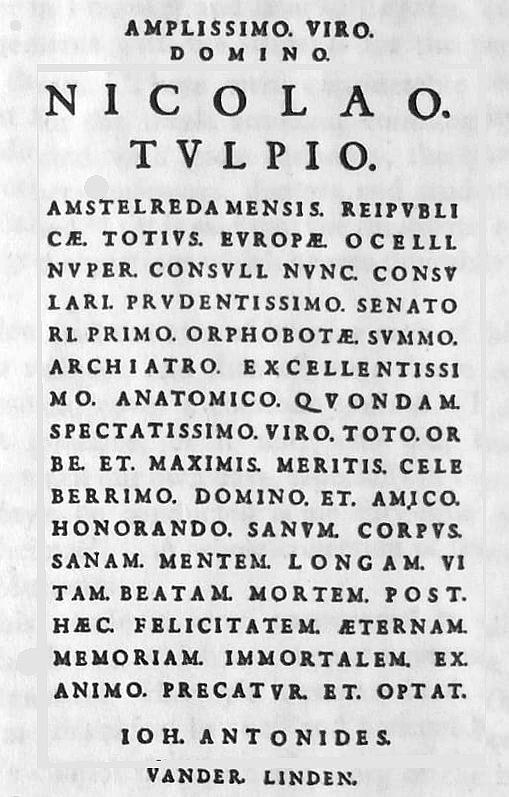
Fig. 7. De scriptis medicis. Dedication in the third edition, 1662.
The most valuable (to his contemporaries) of his editions were those of the
great classics Hippocrates and Celsus. The weaknesses of Galenic and
Avicennian medicine were beginning to be recognized in the seventeenth
century, and the growing impatience with the dogmatism and scholasticism
of Galen and Ibn Sina favoured an Hippocratic reaction. Vander Linden
rode the crest of the Hippocratic wave in Holland. His very serviceable
edition, the best of many of the seventeenth century, represents the new
Hippocratic spirit on the philological side, even as his younger contemporary
Thomas Sydenham (1624-89) revived it in a more practical and original manner.
Vander Linden's deep and long study of the Father of Medicine was natural
enough; it was to a large extent a return to common sense. His edition
of Celsus was equally natural, for Celsus, whose work is full of Hippocratic
reminiscences, was the champion of Hippocratism in Roman days. Moreover,
14
his fine Latinity made him especially acceptable to the medical students and
convenient for the medical teachers of the seventeenth century. As these were
lecturing in Latin they could quote Celsus as easily as if he had been one of
their own colleagues.
The point to bear in mind is that Vander Linden's editions of Hippocrates
and Celsus were not simply philological exercises, as they would be to-day.
He published them to facilitate his students' work and his own teaching.
These were not classics to be admired but living text-books to be conned. It
is highly probable that Vander Linden considered such editorial work as an
essential part of his duty as professor of practical medicine.
V. Views on the Circulation of the Blood
As a professor in Franeker and later in Leyden, Vander Linden was obliged
to make arrangements with his students for the preparation and defence of
their doctoral theses. These were considerable events, not only for the
'doctorandi' but for the whole academic community. Each 'soutenance de
thèse' was conducted with great formality, the thesis was disputed by the
president and other professors, doctors and students, and the disputations
frequently published.[14] It is said that the candidate's friends would sometimes
make pre-arranged objections which he was thus able to overcome in a brilliant
manner!
Vander Linden had the idea of inviting each of his students to deal with a
part of a larger subject, and then all their theses and the disputations con-
cerning them would cover a common ground. I do not know whether he
originated that practice, or if not, who did, but it was developed by
other professors until our own days, especially in German universities. During
his Franeker days he conducted some fifty-nine physiological disputations
'de natura medicinae'. A whole collection of them (dated 1648-50) is kept
in the British Museum.
In Leyden his students were encouraged to discuss the theory of the
circulation of the blood, which was then the greatest physiological novelty and
still on the defensive. Harvey's immortal book De motu cordis et sanguinis
was published at Frankfort in 1628 and had not been kindly received on the
Continent. We cannot tell again the story of the battles which were fought
on that subject, for that would take us too far afield. On account of the
opposition of Jean Riolan the Younger and of Guy Patin, the Parisian faculty
was particularly hostile to the English doctrine. It was easy enough for
Patin to make fun of the 'circulators'.[15] The scientific opposition decreased
after Riolan's death (1657), but the professional opposition continued until
Patin's death (1672). In his Malade imaginaire (1673) Molière discredited
what remained of it.
It would seem that Vander Linden's interest in the circulation, or rather
his keenness in debating it, was started by his Groningen colleague, Antonius
14 For more details see Maurice Raynaud, Les médecins au temps de Molière, 2nd ed., Paris,
1863; Paul Delaunay, La vie médicale aux VIe, VIIe et VIIIe siècles, Paris, 1935. (Isis,
xxv, p. 298). Their information is largely derived from French sources, but essentials did
not vary much from one country of western Europe to another. The ceremonies of medical
graduation were amusingly lampooned in Molière's last play, Le malade imaginaire (1673).
15 The Latin word 'circulator', meaning pedlar, was used early to designate a quack. Celsus
uses it in that very sense (V. 27, 3).
15
Deusing (1612-66). He contributed to the latter's double memoir De motu
cordis et sanguinis itemque de lacte (Groningen, 1655), the first part of which
was rather favourable to Harvey, the second less so. Soon after the deaths of
Riolan and of Harvey (1657), from 1659 to the end of his own life, Vander
Linden directed his medical students to investigate the Hippocratic views on
the circulation of the blood. There are twenty-seven theses on the subject
Hippocratis de circuitu sanguinis exercitationes (Leyden, 1659-63). The sets of
these in the British Museum and in Holland being unavailable to me at present,
[have no detailed knowledge of their contents.[16] It is probable that the
arguments were not restricted to Hippocrates versus Harvey but that other
predecessors of the latter were considered.
This reminds us that violent objection to a discovery, especially to one which
is as disturbing as it is great, passes generally through two stages. The first
stage is that of denial, best represented by the Parisian anti-circulators:
Harvey's theory is wrong, it is plain nonsense, etc. When that position
becomes untenable, the second stage begins: The discovery is all right, but
Harvey did not make it; it was made by many other people before
him.
It was Vander Linden's originality, as the foremost Hippocratist of his day,
to claim that the Father of Medicine had anticipated Harvey! For example,
he found in the apocryphal περì ἐνυπνίωv ('de insomniis') the phrase
ποταμοί δέ μή κατά τρόπον γινόμενοι αἵματος περίοδον τεμαίνουσι (like rivers
not comporting themselves according to wont when the course of blood is
cut); translated αἵματος περίοδον by 'sanguinis circuitus'; and concluded:
'There cannot be the shadow of a doubt that the circulation of the blood
was known to Hippocrates'!
This is a good illustration of the philological mind at work, mistaking
words for realities. Unfortunately, Vander Linden was wrong even from
his literal (non-experimental) point of view. Though the word TEpiosos
might mean 'circuit' and 'orbit', it also means 'period' (as for the periods of
menstruation or the fits of a fever), and the two ideas of closed circuit and of
periodicity which he confused are in reality very different. The geometrical
symbol of the first is a circle, that of the second a sinusoidal curve. Vander
Linden did not realize that in the idea of a circuit the emphasis should be
placed on its being closed, and that Harvey's originality and greatness
consisted in having been the first to prove that the blood circulated indefinitely
along a single closed circuit. All the claims made for Harvey's sixteenth
century predecessors are vitiated by that fundamental misunderstanding.
If circulation means anything it means a closed circuit, as opposed to a more
rhythmical movement as suggested by the pulse. Neither the so-called
small nor the systemic circulations are complete; neither could be self-
continuing, for they carry the blood from one side of the heart to the other
side absolutely cut off from the former.
It must be admitted in Vander Linden's defence that Harvey's
explanations were not always sufficiently clear. In his eagerness to give
Galen as much credit as he could, Harvey tended to perplex hasty readers,
especially those who were more philologically than experimentally minded.
16 I must be satisfied with information given by Willis (1878, pp. 21-5, 323-4).
16
A modern physician making Harvey's discovery would describe it more
briefly and more effectively. We should not forget, however, that his main
difficulty (as is the case with every capital discovery) lay not so much in
explaining the discovery as in destroying the prejudices making its acceptance
impossible. It is clear that Harvey did not do that very well; witness the
fact that the general acceptance of his discovery was delayed for almost half
a century.
Vander Linden was strongly prejudiced against Harvey. Whether this
was a matter of national anti-English feeling, or whether there were other
personal causes, we do not know. It is certain that the last five years of his
life were largely dominated by his opposition, not to the circulation, but to
Harvey. He did not claim, of course, that Hippocrates had anticipated
Harvey completely. Harvey had done something, but his idea had been
suggested to him by somebody else, 'Sarpi, or Heriot or Caesalpinus' (Vander
Linden as quoted by Willis, p. 324). The names of Andrea Cesalpino
(1519-1603) and Fra Paolo Sarpi (1552-1623) are familiar to students of the
sixteenth century and of this particular controversy, but they will ask 'Who
is Heriot?' George Heriot (1563-1624) was jeweller (and money-lender) to
James VI of Scotland and continued in the latter's service after his accession
to the English throne as James I. He founded Heriot's Hospital in Edinburgh
(opened 1659). 'Jingling Geordie' in Scott's novel The Fortunes of Nigel
(1822) is an idealized portrait of him. That is the man who had the first
idea of the circulation! Dr. Nicholas Oudart[17] had heard Harvey admit it
himself in a public lecture; Oudart told that story to Vander Linden, who
was glad enough to report it. Harvey, the discoverer? No, indeed, but
Jingling Geordie! The story itself is not impossible; the idea of circulation
(of a complete circulation) may have occurred to other people than Harvey,
but Harvey was the first to seize that idea vigorously and to prove its truth.
That is what constitutes a scientific discovery; to have a hunch or make a hint
is but the seed of one, a seed which is bound to remain sterile unless there is
a Harvey to take care of it.
After Vander Linden's death his kind of opposition to Harvey was kept
alive for some time, e.g., by the Paduan doctor, Geronimo Barbato whose
Dissertatio elegantissima de sanguine et ejus sero, in qua ... Lindeni ... circa
sanguificationem opiniones ... exponuntur[18] was published in Paris and
Frankfort, 1667, and reprinted in Leyden as late as 1736; and by the Dutch
medical philologist Theodorus Janssonius Almeloveen (1657-1712), who had
the originality to introduce in his Inventa nov-antiqua (Amsterdam, 1684,
pp. 223-38) another claimant to the discovery of the circulation-whom would
you guess ? - Nemesios of Emesa (fl. c. A.D. 400).[19] Almeloveen's Inventa nov-
antiqua, a copy of which I obtained from the Boston Medical Library, is a very
17 Nicholas Oudart (d. 1681) was born in Malines (Belgium) but established himself in
England. He was secretary to Charles I, to the Princess Mary of Orange, and finally to Charles II
(DNB, xlii, 353; Nieuw Nederl. Biog. Woordbk., ii, p. 1041).
18 Barbato is supposed to have been the first to distinguish the blood serum. At any rate,
the word serum occurs in the title of his book.
19 The suggestion that Nemesios adumbrated that discovery had first been made by Dr. John
Fell (1625-86), dean of Christ Church and bishop of Oxford, in his anonymous Greek-Latin
edition of Nemesii de natura hominis (p. 11 of preface, Oxford, 1671).
17
curious book.[20] It is a history of medicine written in a spirit which may seem
paradoxical to us, but was typical enough of that age, the author's main
purpose being to show that modern discoveries had been anticipated by the
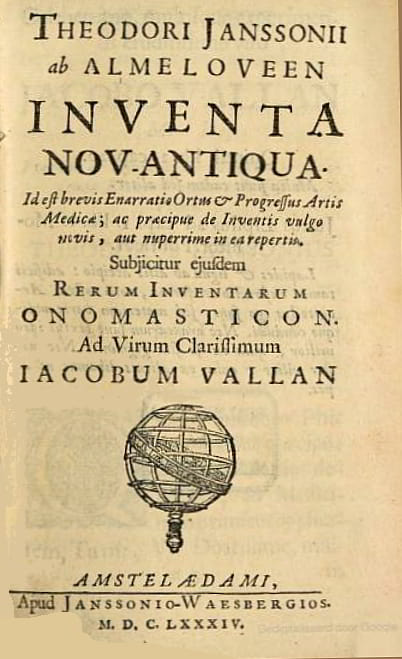
Fig. 8. Title-page of T. J. Almeloveen, Inventa nov-antiqua, Amsterdam, 1684.
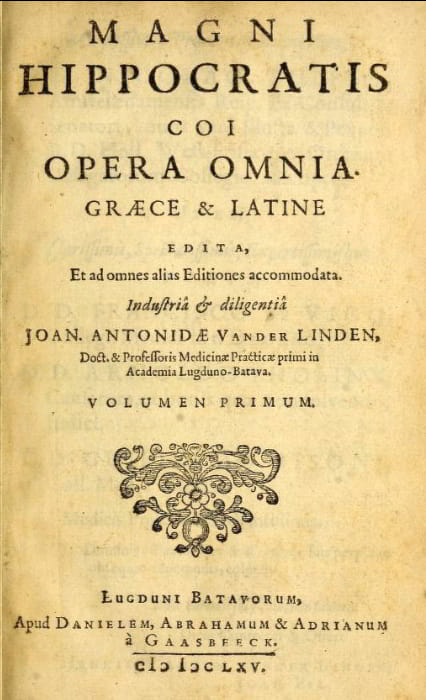
Fig. 9. Title-page of Vander Linden's 'Hippocrates', 1665.
ancients. Read the full title of his book in our facsimile (reproduced by
permission of the Boston Medical Library); but the first words may suffice.
The 'inventa' which he discussed are, he claims, not 'nova' but 'nov-antiqua'
20 It is 15,5 cm. high; 30+249+7=286 pp. Engraved frontispiece showing a man taking
notes from Hippocrates; the works of Rufus, Galen and Avicenna are close to him.The
Onomasticon following the main text is paginated separately (92 pp.).
18
(what language is that?). Harvey is barely mentioned in his chapter on the
circulation. Some of the most learned people he remarks (referring to Vander
Linden and his school) have been discussing whether the circulation was
already known to Hippocrates or only invented by Harvey. There are strong
arguments on both sides, and a decision is very difficult, but it is clear enough
that he is not on Harvey's side. In his list of inventions following the main
reatise, I found references to Fabricius, Bartholin, Pecquet, none to Harvey.
The circulation of the blood is not mentioned! Almeloveen's selection of
inventions is fantastic; it ought to be published some day with a brief
commentary to illustrate the muddle-headedness of a very learned Dutch
physician towards the end of the seventeenth century. It is almost
unbelievable. As far as the circulation is concerned prejudice against Harvey
was the primary factor, and obstinacy the second. The Dutch are stiff-
necked people. Obviously Molière's sarcasms had not yet reached
Amsterdam in 1684.[21]
This digression on Almeloveen is not irrelevant, for after all, Almeloveen
continued Vander Linden's game and carried it to the point of absurdity.
It was distinctly a philological game, which could be played well only by
people considering words rather than realities, verbal analogies rather than
experiments.
The works of Vander Linden and Almeloveen are good examples of the
learned medicine of the seventeenth century. The lack of experimental
spirit of those people was their main handicap; not only did it prevent them
from making new discoveries themselves, but what is worse it vitiated their
own efforts, for it made it impossible for them to interpret correctly the
discoveries of their predecessors.
Fortunately, Vander Linden's main book, the De scriptis medicis, the only
one which has retained to this day some usefulness, does not suffer too much
from that handicap, for it is restricted to external bibliography, to an
enumeration of titles, which, in spite of its barrenness, is very valuable.
VI. Iconography
As Vander Linden was a friend of the Tulp family, one of whose members,
Nicolaes Pieterszoon, had been immortalized by Rembrandt's brush in 1632,
one might expect to find a portrait of him by the same master. Rembrandt
did etch Vander Linden's portrait, but only posthumously.
The story can be summarized as follows: The Mauritshuis owns portraits
of J. A. vander Linden and his wife, Helena Grondt, two separate canvasses
88×(70 cm.) painted by Abraham Van den Tempel (1622-72) in 1660.22
In an early catalogue of the Mauritshuis (Abridged Catalogue, 1904, No. 396)
it was stated: 'This picture is nearly a true copy after Rembrandt's etching
of 1647 representing the same scholar.' Rembrandt's etching was thus
considered as the fundamental portrait.
21 Almeloveen was more of a philologist and theologian than of a physician, yet he was
professor of medicine in Harderwijk. His cognomen as member of the Leopoldina Academy
was Celsus secundus! He was decidedly queer (Nieuw Nederl. Biog. Woordbk., vi, pp. 31-2).
22 Both purchased in Paris, 1876 for 1540 frs. From 1922 on loan to the town museum
(Lakenhal) of Leyden. Van den Tempel painted also a smaller portrait of Vander Linden
kept with other professors' portraits in the University of Leyden.
19
That is not true. Van den Tempel's painting is the original portrait
painted from nature when Vander Linden was fifty-one years old and had
reached the peak of his fame. After Vander Linden's death, when his son
Henrick was seeing the Hippocratic edition through the press, Rembrandt was
commissioned by the publishers, the Heeren Gaesbeeck of Leyden, to make
an engraving after Van den Tempel's painting, which would serve as a
frontispiece. Though he had given up etching four years earlier, Rembrandt
executed the commission. He handled his burin almost as if it had been an
etching needle, and the result is a very subtle dry-point, tantalizing, very
different in spirit from Van den Tempel's solid painting. The publishers
rejected the etching which was not used for the book.[23] However, prints were
made from the plate 'avant la lettre', a rectangle being reserved below for an
inscription which was never engraved.
Why was Rembrandt's etching rejected? It is possible that it was submitted
to Van den Tempel, who disliked that interpretation of his work. Or the
publishers may have thought that the etching was not strong enough for
printing in as many copies as the edition required. Or Vander Linden's
family may have vetoed a portrait too delicate for their bourgeois complacency.
What was Rembrandt in 1665 anyhow? In the eyes of the world he was a
bankrupt. From 1656 to the end of his days all his earnings went to creditors
whom he was never able to satisfy. At the time of his death in 1669 he was
still owing them lots of money. The great man was disgraced and there
was no need to have any regard for his feelings .... There is but one
Rembrandt in a century and hundreds of Vander Lindens, but how could
their professorial and doctoral pride see that?
Another engraving was made from Van den Tempel's painting by the
French artist, Louis Cossin (1633-82). This was used again in the collection
Fundatoris, curatorum et professorum ... effigies published by Pierre Van
der Aa in Leyden, c. 1720.
In short, J. A. vander Linden was very fortunate in having his countenance
faithfully registered by a good painter, Van den Tempel, and later transfigured
by one of the greatest masters of all time.
For the writing of this section, I am indebted to Mr. Henry P. Rossiter,
curator of prints at the Boston Museum, and to my colleague, Otto Benesch,
who drew my attention to the Bredius paper of 1909. The following works may'be consulted:
Fundatoris, curatorum et professorum celeberrimorum, aliorumque illustrium virorum,
quorum gratiâ, favore, curâ, doctinâque Academia Lugduno-Batava incepit, aucta et
ornata est, Effigies ... (2 parts, folio, Leyden, c. 1720?). Vander Linden's portrait
occurs in the second part, No. 95 of the whole series.
Bredius, Abraham. 'Rembrandt als plaatsnijder.' Oud-Holland, Amsterdam, 1909,
xxvii, 111-4, 2 Pl :.
Hind, Arthur M. Catalogue of Rembrandt's etchings. 2 vols. London, 1912. (The
revised edition, 2 vols., London, 1923, was used.)
Benesch, Otto. Artistic and intellectual trends from Rubens to Daumier as shown in
book illustration. Cambridge, Harvard College Library, Department of Printing
and Graphic Arts, 1943, pp. xvi+91, 66 illus. [p. 26.]
23 Documentary evidence published by Bredius in 1909.
20
VII. Bibliography
Vander Linden's own works, or at least the main ones, are listed in
Sections II to IV of this article. The present list includes only his De
scriptis medicis as a source of reference concerning himself.
Baumann, E. D. Art. on J. A. vander Linden in Nieuw. Nederl. Biog. Woordbk.,
1927, vii, 770; Biographie nationale ... de Belgique. 28 vols. Brussels, 1866-1944.
Biographisches Lexikon der hervorragenden Ärzte aller Zeiten und Völker. Second
edition, 6 vols. Vienna, 1929-35.
Cocceius, Joannes. Oratio in J. A. vander Linden funere. Leyden, 1664.
Descartes. (There are no references to Vander Linden in Descartes'
correspondence.)
Feriae parentales in ... excessum ... }. A. vander Linden. Leyden, 1664.
Linden, J. A. vander. De scriptis medicis. Amsterdam, 1637, pp. 242; editio altera,
Amsterdam, 1651, pp. 312; editio tertia, Amsterdam, 1662, pp. 317.
Mercklin, George Abraham. Lindenius renovatus. Nurnberg, 1686, p. 516.
Molhuysen, P. C. Bronnen tot de geschiedenis der Leidsche Universiteit. Derde deel,
I657-82. 's-Gravenhage, 1918.
Nieuw Nederlandsch Biografisch Woordenboek. 10 vols. Leyden, 1911-37
Siegenbeek, Matthijs. Geschiedenis der Leidsche Hoogeschool van 1575 tot 1825.
2 vols. Leyden, 1829-32.
Viets, Henry R. The bibliography of medicine. (Pp. 15, illus.) Privately printed,
Menasha, Wisc., 1938. (See Isis, xxxi, 273.)
Willis, Robert. William Harvey. A history of the discovery of the circulation of
the blood. London, 1878.
>> begin